Where's the book?

Tuesday, September 24, 2013

Jane, Jane. And Curtis.


My figlio maggiore (a/k/a older son) used to live next door to a grad student in English who had a bumper sticker on her car that I really liked. “I’d rather be reading Jane Austen,” it said. Interestingly, the owner of the car was a scary looking lesbian with a lot of piercings and a shaved head. Which proves, if you ask me, that Jane has something for everyone.

I’ve read all of Jane’s books many times over and if I had to pick a favorite it would be Sense and Sensibility. Or maybe Pride and Prejudice. Or maybe Persuasion. It’s like a Sophie’s Choice (another good book): I love all of them so much that I hate to choose just one.

But I can say with confidence that my least favorite is Northanger Abbey, which means I just love it with half my heart, not all of it. I re-read it again a couple of weeks ago (#36) and it’s an awful lot of fun, but it’s Jane Austen light. Or maybe even “lite.” It’s as if Jane wrote a young adult novel: The main character, Catherine Morland, is a somewhat silly 17-year-old and even though the other characters in Jane’s books are young (Elinor Dashwood—the possessor of such great “sense”—is all of 19 and her sister Marianne is 16! wise Elizabeth Bennet is just 20!) Catherine feels young: childlike, unperceptive, vastly naïve. The story is slim—Catherine meets a cute guy, a false friend, a good friend, a not-so-cute guy. It feels a little like high school. In fact, false friend Isabella Thorpe could be a prototype mean girl. It’s thoroughly entertaining, and of course has the requisite Jane Austen happy ending. If I had a teenage girl to introduce to Jane, this would definitely be the book I’d start with.

The R-rated Mansfield?
But after Northanger, I needed some Jane with a little more meat. Since I try to rotate them in order, that meant Mansfield Park (#37), which is possibly my next to least favorite Austen novel, which means that I only love it with three quarters of my heart. The story certainly has more meat to it, and some wonderful characters, but for me the little worm at the core of the apple are the two main characters: Fanny Price and Edward Bertram. Fanny is so timid, so reticent, that she almost vanishes from the page. She’s too good, too simple, too sweet. And Edward comes across as a bit of a judgmental prig. But everything else is pure cream. Fanny’s aunt, Mrs. Bertram, is a marvelous portrait of a woman so indolent she’s practically catatonic. And her other aunt, Mrs. Norris (the cat in Harry Potter was named for her), is one of Jane’s wonderful nasty comic women, cruel to poor (literally and figuratively) Fanny, grasping, self-congratulatory, and hilariously miserly. The story bounces along as only Jane can bounce it, with appropriate punishments for the wicked and rewards for the good, a wedding and a happily ever after.

#38 required a departure from Regency England, and a jump across the pond to a ritzy New England boarding school and the novel Prep by Curtis Sittenfeld. Although it’s about a young woman and her coming of age, it’s worlds and lifetimes away from a Jane Austen novel, not only in its setting, but in its style. Like Jane, Sittenfeld writes wonderful dialogue, but unlike Austen, her plotting is almost non-existent. There’s not so much a story as a diary of four years in the life of our main character, a scholarship student from faraway (yet not at all exotic) Indiana. Lee Fiora, the narrator, struggles academically and socially, and is so withdrawn as to almost fade from the page. Her insights about class and money and teenage interrelations are occasionally fascinating, but for much of the book I just wanted her to get out of her dorm room and do something…anything! Go to a movie, get high, make friends, join a team, pick a hobby! She is intimidated by everything, and she knows it, and she spends most of the book analyzing it. She’s insightful about her own state of passivity, but it never changes, and it eventually gets old. When things finally start happening in senior year, there’s a bit of a plot, but not much. A novel without a plot isn’t much of a read. Sittenfeld should have spent some time studying Austen, if you ask me.  

Thursday, September 5, 2013

Why I'm not a mathematician

Isaac Newton. He could count.
Mainly because I can't count.

My last entry was called book #33.

And the entry before that was called, "29, 30, 31, 32..." But it only covered three books. So it should have been "29, 30, 31..." And the next book should have been counted as #32. 

Which makes this next one book #33. And which makes me really bad at math. Or at least at counting.

And now here are, if I've counted correctly, numbers 33, 34, and 35. I think.


#33. I picked Summer Reading out of the pile at the used book store
because I was looking for something by Meg Wolitzer, having loved The Interestings. My search was unsuccessful -- nothing by Meg -- but they did have a book by her mother, Hilma Wolitzer. I was curious to see if their writing styles were similar, and they are. But Summer Reader is Wolitzer light, or lite. It's a moderately entertaining book, a quick read, revolving around a summer reading group of wealthy women in the Hamptons. The books they read are all favorites of mine and it was pleasant to see how references to Vilette or Madame Bovacy were woven into the story. But it made me want to read one of those richer, deeper books again, instead of this thinner imitation. 

#34 was the September choice for my book group (thank you Maggie), and it was an unusual one, by an author I'd never heard of and will now have to look up to make sure I get the spelling right. Skylark by Hungarian author Dezso Kosztolanyi was written in the 1920s and set around 1900 in a small town in what was then the Austro-Hungarian Empire. The story covers one week -- one strange and glorious week in the lives of what the author refers to as an "elderly" couple (they are in their late 50s). Their much-loved thirty-something year old spinster daughter, Skylark, has left for a week to visit relatives. They weep at her departure and then, slowly, they begin to bloom in the absence of their humorless, oppressive, loving, stultifying warden. They go out to restaurants. They go to the theater. They drink and play cards and see friends and laugh. All the things they do not do when their beloved Skylark is home. The story is quite subtle, funny at times, and deeply moving. You do not recognize the point at which you realize that Skylark is almost as much hated and feared as she is loved. It's a wonderful, quiet, sympathetic, magical book. 

#35 is a newbie: I picked up The Yonahlossee Riding Camp for Girls by Anton DiSclafani because (a) like The Interestings, it's another novel about camp, and I like camp and (b) I bought the hype. The setting in this story is a combination riding camp and school for girls in 1930, and the main character is Thea Atwell, a teenage girl who has been sent away from her idyllic Florida home for some awful deed. What the deed is and why Thea has been cast out of Eden becomes slowly clearer as the story moves along, and although at first I was irritated by DiSclafani's careful doling out of hints, I was eventually drawn into the story, and the sexual charge that underlies the book. It's a bildungsroman for girls, a thankfully subtle story of a complex young woman learning about life and herself. In lesser hands it would have been a silly teen novel about girls and boys and sex and bad deeds. But DiSclafani is better than that, and although her deliberate style got on my nerves, and almost all the characters other than Thea are tissue paper thin, Thea is thankfully complex, and bold, and intelligent, and unapologetic. I can't say I loved the book, but I liked it. And I'm looking forward to the movie. Jennifer Lawrence, I assume? 

J.La as Thea? I'm down. 

Tuesday, August 27, 2013

The best was yet to come

I actually finished #33 before the last reading round-up post but I decided to wait, because this book deserves a post all its own.

Frank McCourt, no stranger to lyrical Irish tale-telling himself, called Colum McCann's Let the Great World Spin a "groundbreaking heartbreaking symphony of a novel," which says it all. It is a symphony -- multiple threads of melody that weave in and out, sometimes almost without the reader (or listener) being aware of the all the lines that come together so perfectly, so beautifully. The past weaves into the present, and then again into the future. And all of it is braided so brilliantly together.

It's the story of New York in August of 1974 -- of one week, which was the week that Philippe Petit crossed the high wire on the World Trade Center, the week that Nixon resigned, and the week that I moved to Manhattan. One thread -- a minor one -- tells us of the high wire artist and the city's response to it. But all the others are of people we would never read about in the paper: an Irish monk living in the Bronx projects, a mother-daughter pair of prostitutes, two women who have lost their sons in Vietnam, a judge in the overloaded Manhattan courts, an artist who is thrown from one life to another when her car taps another on the FDR Drive. And more, many more. Each story ties to the others and each brings another life to full, rich, real existence. As much as you are sad to leave one story behind, you are immediately, fully immersed in another.

I was stunned by the beauty of this novel. I was equally stunned by how it thrust me back into the New York I moved to in August of 1974, the grit, the rough texture, the feral atmosphere. But this book does not dwell on the darkness or the misery. It's the kind of book that left me feeling joyous, that made me want to start it over again right away, that made me want to sit, and think, and breathe deep, and talk about it, and give copies to everyone I know.

In addition to being in love with the book, I am also in love with its author. The paperback of the book contains an interview with McCann. In it he says that this book is his emotional response to 9/11. He says, "It's my stab at personal healing. I'm not here to preach. I just lay out a landscape so that people can walk into it, or walk out, hopefully with their souls shifted sideways an instant."

Isn't that a wonderful description of what happens when we read something marvelous: our souls shift sideways an instant.

But what finally made me love the book is its heart. It is a story -- a symphony of stories -- filled with a powerful compassion, a compassion based on understanding and faith, not the God kind, but the faith in people that seems so outdated today. I wasn't surprised to hear McCann say, in that interview at the back:

"It's strange, but as I grow older, I find myself developing more optimism. I keep inching toward the point where I believe that i's more difficult to have hope than it is to embrace cynicism. In the deep dark end, there's no point unless we have at least a modicum of hope. We trawl our way through the darkness hoping to find a pinpoint of light. But isn't it remarkable that the cynics of this world--the politicians, the corporations, the squinty-eyed critics -- seem to think that they have a claim on intelligence? They seem to think that it's cooler, more intellectually engaging, to be miserable, that there's some sort of moral heft in cynicism."

And one last beautiful, big-hearted word from the author:

"I think that a good novel can be a doorstop to despair."

I will now read everything else Colum McCann has ever written and then wait, impatiently, for more.


Tuesday, August 20, 2013

29, 30, 31, 32...

Disappointment reigns...I've fallen short of my book-a-week resolution, which was a shaky resolution at best. I usually read about 48 or so books a year, at least for the last few years when I've kept track. Which means an average of 4 books a month, some months more, some less. But the tidy numbers-keeper within me loved the idea of a book a week, so I made that my goal, with the (silent) understanding that I didn't need to make myself nuts in order to fulfill it. After all, the object isn't racing through book after book, but reading for the pleasure, the elucidation, the enlightenment. It's about the journey, not the finish line. But what a finish line -- a book a week! I once read an article about a woman who read a book a day for an entire year, which thrilled me enormously. What an idea! A book a day. And somehow she also managed to blog about them here. I'm can't remotely imagine how she did that (and still raise 3 kids and presumably sleep), but that was a goal beyond my imagining. A book a week, now...that I could see. But summer and its attendant distractions (beaching! boating! hosting) has thrown me off the righteous path and here I am in week 34 with only 32 books read. Perhaps I will have to play catch-up with a couple of quickies. Except I also vowed to read this one over the summer and it won't fit easily into my book-a-week plan. Maybe I'll save it for next summer. We'll see...

In the meantime, here's a quick look at where I've been. Some wonderful reading time has passed.

#29 A rose by any other name would still write as sweet
 I thoroughly enjoyed the Harry Potter books. Read every word, saw every movie, loved every minute. I thought JK Rowling was a bit of a modern Dickens -- great characters, rollicking story lines, bad guys and good guys and lots of drama. So when I read about the mystery she wrote under a false name (Robert Galbraith) I immediately bought a copy of The Cuckoo's Calling on iBooks. It didn't disappoint. The first in what she plans as a series of mysteries starring a one-legged PI named Cormoran Strike (her talent for names has not deserted her), Cuckoo is a fun, confident read. Although there seemed to be some small holes -- pinholes, really -- in the plot (I felt that way about Harry Potter, too), the story bounced along, and Cormoran and his smart, warm-hearted assistant Robin (he's Batman, get it?) are very appealing characters. I would definitely follow their adventures in future Strike mysteries.

#30 Movies and books have so little in common
Greer Garson as Elizabeth Bennet
I've seen the movie of Mrs. Miniver ages ago, starring the wonderfully resolute Greer Garson (still my favorite Elizabeth Bennet, despite the fact that she looks closer to the age Elizabeth's mother should be) and loved it. So when I came across the book in a used bookstore, I grabbed it, only to find out that the movie and the book have about as much in common as Greer Garson and Keira Knightly.
Keira Knightly as Elizabeth Bennet


The book is a collection of short essays by Jan Struther, an English writer who is also famous for writing hymns. The essays, each a brief look at the everyday life of a British housewife, were based on Struther's own life and appeared in the London Times from 1937 until 1939. They're lovely, beautifully written, touching peeks into topics as world-shaking as hosting a dinner party and shopping for Christmas presents. Only briefly, towards the end, do the essays really touch on the world at large, once in a very moving piece about the family going to pick up their assigned gas masks, including the miniature models for her two young children. "It was for this, thought Mrs. Miniver as they walked towards the car, that one had boiled the milk for their bottles, and washed their hands before lunch, and not let them eat with a spoon which had been dropped on the floor." She writes also about going to first-aid class and the strange sense of expectation combined with apprehension that has descended on her country. Another woman confides that she likes the class because it makes her feel like she is back at school again. "I know," Mrs. Miniver thinks, "that's the whole point. That is the one great compensation for the fantastic way in which the events of our time are forcing us to live. The structure of our life--based as it is on the every-present contingency of way--is lamentably wrong: but its texture, oddly enough, is pleasant. There is a freshness about, a kind of rejuvenation: and this is largely because almost everybody you meet is busy learning something. Whereas in ordinary times the majority of grown-up people never try to acquire any new skill at all, either mental or physical: which is why they are apt to seem, and feel, so old."

The book was a huge success, in both Britain and the US, where Struther went on an enormously successful lecture tour. The book was such a hit that Franklin Roosevelt credited it for hastening America's involvement in the war. Winston Churchill supposedly said that Mrs. Miniver did more for the Allid cause than a flotilla of battleships.

#31 Did I mention that movies and books have so little in common?
Boris Karloff as Frankenstein's creature
As different as Mrs. Miniver book and movie are, the book and movie of that old favorite Frankenstein are so different they are barely relatable. Yes, they both revolve around the story of a man who plays God by creating a human, and his name is Frankenstein (the man, not the creature, who has no name). But that's about it. In Mary Wollstonecraft Shelley’s book, the creation portion takes about a paragraph. The rest of the many pages are about the pursuit of the creature to destroy his creator and then the creator to destroy his creature. The story is framed like Heart of Darkness -- it's told by an Arctic explorer who has taken the Doctor on board his ship in letters to his sister. The book covers enormous territory as the various pursuits occur. And, most importantly, the creature’s story is half the book. He speaks! He reads! He thinks! He is much, much more than a grunting evil being depicted in the movie. It’s a deeper, richer story, with elements of religion and classical and biblical mythology and one I’m thrilled I’ve finally gotten around to reading.

My favorite Frankenstein creature: Peter Boyle in Young Frankenstein

Saturday, August 3, 2013

Berry berry delicious

Summer is a delicious season, and I mean that in the most literal way. The corn! The tomatoes! The fruit! While I barely open my mouth for fruit the rest of the year (apples and oranges and pears, oh meh!), in summer I can't get enough of the sweet berries and melons and peaches. And out here in farm country where I am so fortunate to spend the warm weather months, fruit is bountiful and near-perfect. And oh-so-seasonal. This year, thanks to a family wedding and other requirements that kept us in town well into June, we just about missed the strawberry season, which peaks around Father's Day and is done by 4th of July. But we made it in time for all the other wonderful fruits.

Of course, even the most seasonally perfect fruit is better with a little something added, like a crust, or whipped cream, or vanilla ice cream, or some shortbread. At least, IMHO. My significant other feels quite differently. Once, when asked by a friend to name his favorite dessert, he squinted slightly, gazed thoughtfully at the ceiling, and said, longingly, "A perfect peach."

To me, even the Platonic ideal of peach would not be enough to qualify as dessert. So the question looms: What is the best way to deal with the fruitful bounty of summer? Pie? Not really. Pie is just fruit that's been herded into a pasture and fenced in with crust, and even the best pie crust is nothing to write home about. Tarts are way too fussy for beach season. Crisp and brown betty and cake (here's a wonderful recipe for strawberry cake from my favorite food blogger, Smitten Kitchen--and it works equally well with blueberries or other fruits) are all great, but surely the all-time winner for summer dessert is a perfect cobbler.

A perfect cobbler is a the greatest thing in the world. Well, perhaps except for a nice MLT...


Forgive my digressions, but there's always room for Miracle Max. Now back to cobblers. A cobbler is the ne-plus-ultra summer dessert, simple to make, easy to eat, fresh, sweet, happy. The challenge, for me, was combing up with the right balance of fruit and cake. Since I am not a fruit worshipper, I wanted more cake than fruit, but a light cake. Not a biscuit, although that's good, but also not a sugary cake, although that has its place as well. A somewhat sweet, cake-y cobbler with barely sweetened, summery fresh fruit.

I found the perfect recipe years ago in the New York Times, courtesy of Mark Bittman, a culinary hero. You can whip up the cake in the food processor in a minute or two, or by hand if you prefer. I have doubled the amount of cake but you can halve it if your fruit:cake ratio preference is different from mine. In that case, remember not to halve the amount of sugar in the fruit, only the cake portion. You can also sweeten the fruit to taste; I prefer less sweet fruit if it's fresh and naturally sweet. You could also add a bit of cinnamon, ginger, allspice, cloves, etc. Or grated lemon zest. And, best of all, this recipe works equally well with any type of berry (mix them up or add chopped rhubarb, which might require slightly more sugar), peaches, nectarines, or even apples or pears, but who wants to think about apples and pears when peaches and blueberries are at hand? It's summer, the sweetest time of year.

FRUIT COBBLER
4-6 cups berries, washed and well dried, or other fruit
1 1/2 cups sugar, or to taste, divided
16 tablespoons (two sticks) cold unsalted butter, cut into bits (more for greasing the pan)
1 cup all-purpose flour
1 teaspoon baking powder
Pinch or two of salt
2 eggs
1 teaspoon vanilla extract

  1. Preheat the oven to 375 degrees. Toss the fruit with 1/2 cup of sugar (or to taste) and spread it in a lightly buttered baking pan. 
  2. In a food processor, combine the flour, baking powder, salt and 1 cup sugar and pulse. Add butter and process for 10 seconds, until well blended. Beat the egg and vanilla together and add.
  3. Drop the mixture onto the fruit by tablespoons. Don't spread it out, just plop it there. Bake until starting to brown, 35-45 minutes. 
  4. Best served warm with whipped cream or good vanilla ice cream. If you have leftovers (you probably won't) it's great with your morning yogurt. 

Thursday, July 18, 2013

Catching up

My figlio maggiore has been visiting for a couple of weeks, along with his new and adorable and lovable and sweet and affectionate...beagle. Pepper, as he has named the rescued pup, is about two years old, and is the prettiest puppy I've ever seen. Her colorations range from ivory white to chocolate brown to a sweet dark brown patch right on the top of her head. I'm torn between wanting to hug her and wear her. I can see how Cruella De Vil got her start. It always begins with love.

In between spending time with the FigMag and the puppy, and visits to the beach, and trying to stay cool (it's hot here, really hot), and cooking and baking (world's best cobbler recipe, coming soon), there has been plenty of reading time. And since I've been plowing through books like a hot knife through good brie, I'm going to use this space to play a little bit of catch up.


#25 The Interestings, by Meg Wolitzer
The story of a group of young people who meet at an arts camp in the early 1970s. Wolitzer follows them from there through the next three or so decades of their lives. The central character is a girl from Long Island named Julie, who quickly transforms, thanks to the sparkling group of young people she falls in with at camp, into the far more creative "Jules."

I was primed to love this book. After all, I grew up in the New York City suburbs at roughly the same time as these kids (I would be maybe two years older than them). I went to arts camp. I changed my name at 14 from the pedestrian Jill Ann to the far more creative "Jilann." I longed to live in Manhattan, to be creative, to be witty, to be...interesting.

Luckily (for me), I did love the book. Despite covering so many lives for so many years, it never feels thin or contrived. Wolitzer knows these characters inside and out, and by the end of the book, so do we. Although she skips blithely through many major chunks of life (raising kids seems to happen while you're looking the other way), you never feel like she's losing touch with her story. And the book touches on something I can't remember reading about in other stories -- the envy people can feel for the wealth or happiness or achievements of friends, even friends they love. And how to remain friends despite that envy, and through that envy. It's a powerful topic and, in large or small ways, we've all felt it. The books was a rewarding, rich, thoroughly engrossing read. It took me back to my adolescence like a Proustian madeleine and I could smell the bug juice and popsicle sticks of camp.

#26 The Burgess Boys, by Elizabeth Strout
Since I had read and loved Olive Kitteridge I was excited to read another book by Strout, especially since I had seen several good reviews of this one. But I was, sadly, so sadly, very disappointed. One of the things I loved about Olive was her compassionate and loving portrait of so many different and differently flawed characters, including the stiff, cold, proud title character. Strout seemed to have the ability to put herself in so many different skins, and to make them all not only believable, but understandable, even when they behaved badly.

But in this book she seems to have lost her way. The Burgess boys themselves -- two grown brothers named Jim and Bob -- along with their sister Susan -- are all unlikable, particularly the older brother, Jim. A successful lawyer, Jim is arrogant, abrasive, domineering -- almost to the point of abusive. His younger brother Bob seems like a simp for putting up with it, as does his thinly drawn wife. The action revolves around a seemingly racist act committed by Susan's strange son Zach, which drawns Bob and Jim back to the failing Maine town in which they grew up, and in which their father died in a strange accident that has haunted the "boys" ever since.

Bob is meant to be the book's conscience, and heart, but his inability to stand up to either his brother or his nasty, cold (figuratively and literally -- she keeps her house so frigid that Bob has to sleep in his coat) sister Susan, made me lose patience with him. Since Strout does not extend her hand to me as a reader in liking or even fully understanding these characters -- and they weren't entertaining enough to keep me drawn in without some compassion extended toward them -- I found myself bored and irritated throughout. A disappointment, truly.

#27 Billy Lynn's Long Halftime Walk, by Ben Fountain
Although the book has a gimmick -- it takes place during one day in the life of a returning hero from Iraq. Billy and his Bravo squad's battle at Al-Ansakar Canal has been captured on video, and they are media heroes, traveling the country on display, possibly the subjects of a movie, and, most importantly, about to return to Iraq for another tour. On this day they are at Dallas Cowboys stadium, where Billy will drink, smoke pot, meet a Dallas Cowboy cheerleader and fall for her, text, talk, take part in Hollywood negotiations and a Destiny's Child halftime show, and a whole lot more. Except for one extended flashback to Billy's painful visit home, the entire tale unfolds in this one long, crazy day. Billy is a wonderful character -- a 19-year-old boy who has been kicked into the role of a man, and tries, hard, to live up to it. Fountain's language is as wild a ride as his story, it is rich, twisty, evocative. I don't like war stories (even when they don't involve actual war) or male-dominated stories (what could be more male dominated that a book about a war hero?). It was, therefore, not a book I thought I would like, and I didn't like it. I loved it.

#28 Super Sad True Love Story, by Gary Shteyngart
And speaking of wild language... Welcome to the Shteyngart universe. Buckle up, it's going to be a bumpy ride. Falling somewhere on my personal Shteyngart spectrum between The Russian Debutante's Handbook (loved it!) and Absurdistan (hated it!), this book is set in the not-too-distant future when America's economy has collapsed, various foreign powers are taking over (China! Norway!), and war with Venezuela is background music to it all. Our Russian-immigrant hero, Lenny Abramov, works for a company that is developing technology to make immortality a reality (but only for HNWIs -- High Net Worth Individuals), and is involved in a whole lot of other shady dealings as well. The story swings from Lenny's diary to the texts (now called "teens") of his new lady love (a much-younger daughter of Korean immigrants named Eunice Park). Shteyngart's imagination seems to know no bounds, and, thankfully, his vision of the dystopian future seems entirely original. And the book is about many things (consumerism! old world-new world! immigrant mentalities!) but mostly about the real biggies: love, loss, and, above all, mortality. But despite the big themes (and I love a book about love and death as much as the next anhedonic Jew) somehow it didn't all come to life -- I just didn't care if Lenny lived forever or if he and Eunice and her adorable freckles made it work or even if New York City fell apart in the "Rupture" that finally brings America to her knees. It was all too much sizzle and not enough steak.


Tuesday, July 2, 2013

The great 2013 donut crawl part one

The cronut
My younger son (let's call him figlio minore, FigMin for short) loves donuts. Adores donuts. Would marry a donut if it were legal in New York State. And since donuts appear to be pretty hot right now (the new cupcakes? no, that's this monstrosity--and I don't line up at 3 AM for baked goods, like ever--Springsteen maybe, but breakfast pastries? no way) (wait, where was I? oh yes--), since donuts are hot right now, we decided it was time for a donut crawl. In two parts no less. Part one: Manhattan. Part two: Brooklyn. And if Queens or the Bronx get with the program there could be parts three and four. (I don't do Staten Island. Even for donuts.)

We started early in the morning. That is, early in the FigMin's morning, which is around 11. First stop: Culture Espresso on West 38th Street, a little cafe that sells donuts from Dough in Bed-Stuy. Yes, I know this was cheating a bit, but it allowed us to sample one of the many Brooklyn spots, which will make the future BDC (Brooklyn Donut Crawl) a bit easier, since the Brooklyn bakeries are far-flung and hard to get to in one day of crawling.

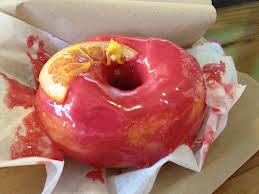
Dough's blood orange creation
I had already tried Dough's creations at the Brooklyn Flea and, wouldn't you know it, the only donut left at Culture Espresso when we got there was one I had already sampled: blood orange. Having sampled it twice, I can confidently say: meh. Maybe orange just isn't the right donut flavor for me (chocolate! and then chocolate! and more chocolate!) but the whole package was too reminiscent of orange-flavored cough syrup. The FigMin agreed, and although we managed to choke it down, it wasn't an auspicious beginning.
The old Penn Station. A palace!

Stop two was supposed to be Krispy Kreme (always reliable), but after wandering around the West 30s, we realized that the KK was inside Penn Station, and since that's probably my least favorite building in NYC (because such ugliness replaced such beauty), we decided to forego it. Besides, we've had KK donuts before, and while they are awesomely tasty, we were on the hunt for something new.

Koreatown donuts before
Koreatown donuts after
Stop three: Koreatown, for donuts from another culture. Donuts from another planet is more like it. There were several possibilities, all of which were strange. But we like strange! We embrace strange! But after this, we reject strange. Donut one (the
thing that looks like a bran muffin in the photo) was filled with red bean paste. I can now confidently state that red bean paste does not make for a good donut filling. Don
ut two (the one that looks like a small loaf of bread) was so chewy we wondered if it was really Korean bubble gum. And donut three (in wrapper) was a shade of green that made it look like it had developed an irradiated mold. Sadly, it tasted no better than it looked. It's the only donut I've ever spit out. Yes, spit out. We couldn't finish them. They were awful. And I've finished some awful food before. Korea may be a rising power in the world, but they have a lot to learn about donuts.

Having eaten a half a donut and three bites (one of them spit out) of other donuts, it was time for something savory. On to Xi'an on Bayard Street for something good (finally). And man, was it good. After a shared spicy cumin lamb burger and two dishes of amazing hand-ripped noodles, we were replenished and ready to return to the crawl. How much did we love our lunch at Xi'an. We made it disappear! Look:

It was good
Onward to the Donut Plant on Grand Street. The donuts there look sooooo pretty. And they sound sooooo good. But they are sooooo disappointing. Look how pretty:


We decided to take them home for later, since we were pretty full from Xi'an's deliciousness. We got a bunch of different types and tastes: yeast, cake, filled, chocolate, coconut, berry. In the interest of science, we sampled them all:


But in the interest of honesty, I have to report, we were disappointed with every single one. We've tried Donut Plant before and didn't love the results, but we were open-minded about this new visit. But we were disappointed again. Donut Plant, you are off the list. Dough, you too. And Korean donuts...well, the less said about them, the better.

The Great Brooklyn Donut Crawl is next. Check back for more.


Friday, June 28, 2013

23...24...

Been too busy reading to write about the reading. But it's time to catch up, and then get back to cooking. I promised baguettes, and breakfast pizza, and report on a recent donut waddle crawl. Had some amazingly bad donuts (didn't think there could be such a thing, did you?) and have decided that there are some very overrated donuts in this city. Give me Dunkin' any day.

But first, the latest reads:

#23: Tiny Beautiful Things: Advice on Love and Life from Dear Sugar. Dear Sugar is the advice column found on The Rumpus, an online literary magazine. Cheryl Strayed, the author of the bestselling memoir Wild and the novel Torch is Dear Sugar and the book is a collection of her columns. It's certainly not your mom's Dear Abby. Strayed creates an entirely new genre by combining literary confessional, memoir, and advice-giving to create what is a deeply moving read. There's the usual mix of cheating spouses, money problems, career issues, young people having trouble growing up, older people having trouble getting it up, and one incredibly powerful letter from a father who has lost a child. Some letter-writers are asking for specific advice, some need a place to rant, some just want to make a connection. Strayed answers every appeal with respect and empathy. I've always loved advice columns--the "Social Qs" column is the first thing I read in the Sunday Times--so I thoroughly enjoyed every bite of these Tiny Beautiful Things, even the ones that made me cry.

#24: The Host. My figlio maggiore often tells me I have the musical taste of a tween girl. I like Maroon 5 and Katy Perry and, excuse me but you'd have to be dead not to bop to them, One Direction. And sometimes my tweeny tastes extend into reading as well. I speed-page-turned my way through all three Twilight books. Loved Hunger Games long before the movie. And so I turned with great expectations (not a book I loved) to The Host, by Twilight author Stephanie Meyer. Can't say I enjoyed it as much as the first Twilight novel, which was un-put-downable, but it was a fun, fast read. It tells the familiar invasion of the body snatchers story, but this time from the POV of the snatcher. It's a moderately interesting twist and a moderately interesting read.

Stay tuned. More to come soon...

Wednesday, June 19, 2013

The poached egg epiphany

I used to joke that I was going to write a cookbook for raw beginners and call it How to Boil Water. Then somebody (Food Network, of course) actually did. My birth mom, who was an amazing cook as well as an author of cookbooks and culinary history books, wrote a beginner's cookbook that she called, How to Slice an Onion. It makes a wonderful gift for kids heading off to their first apartments or any other kitchen newbie, and you can pick up a copy here.

But no matter how experienced a cook you are, there's always something new to try. I've mastered lots of what appear at first to be pretty challenging recipes and techniques. I bake my own bread (baguette recipe coming soon), have made cheese (mozzarella and ricotta), cure my own bacon, and there was even, once, the infamous Night of the Crackers. Yes, I made my own crackers, which took an entire day, and I served them to dinner guests with the cheese platter before the meal. They were a little oddly shaped, and somewhat less tasty than a Ritz. But they were homemade crackers! I was so worn out from the cracker-making that I don't think the rest of the meal was much good. They did, however, become legend, as an example of over-the-top do-it-yourselfishness. And I learned a good lesson. There are some things better left alone, especially things that are completely incidental to the meal. Have you ever heard anyone leave a restaurant exclaiming, "Oh, those crackers!"

A Dementor. Pretty ugly, no?
But despite all the bacon curing and baguette baking, there's one simple item that I've never managed to master: the poached egg. I've tried adding lemon juice and drops of vinegar. I've tried swirling the water clockwise and swirling the water counter-clockwise. But no matter how I swirled and dipped, my poached eggs ended up looking like the shredded ends of Harry Potter's Dementors (but white). Ugly things, my poached eggs.

Until I found a little secret on this cute video, which also reveals the easy way to tell a fresh egg from a not-so-fresh egg (fresher eggs poach more tidily). Don't you love knowing these little cooking tricks? The video reveals this easy tip: crack the raw egg into a fine mesh sieve. That way the watery part of the white drains away, so that when it cooks it stays nice and tight and pretty.


Maybe my fine mesh strainer is finer than most, or my eggs thicker, but I found that the fine mesh did not strain any of the white away. So I tried using a slotted spoon, and that worked perfectly. Plus it made lowering the egg into the simmering water very easy, since the egg was already sitting pertly on a spoon. Very lightly oiling the spoon beforehand made it slide off more readily.

It's a little bit of a balancing act, handling egg and spoon, so cracking each egg into a small cup before starting makes it easier. Then you can just tip an egg into the spoon, let the watery white drain away, and lower it into the water. Use the spoon to gently move them around while they cook, and to lift them out when they're done.

In addition to making my first nicely poached eggs, I also made my first hollandaise sauce. And I used the food processor, so it was ridiculously easy (recipe below). Which means I also made my...drumroll, please...first eggs benedict. Served to a very pleased Figlio Minore. What's next? I'm heading to the country for a bit so I'm thinking smoking. Fish, that is. Onward!


Food processor (or blender) hollandaise

INGREDIENTS
6 tablespoons unsalted butter
2 large egg yolks, room temp
1 1/2 tablespoons freshly squeezed lemon juice
Salt and pepper
Pinch of cayenne

DIRECTIONS
  1. Melt the butter in a saucepan or microwave.
  2. Place the egg yolks, lemon juice, 3/4 teaspoon salt, 1/5 teaspoon pepper, and cayenne in the processor. Blend for 15 seconds. With the processor running, slowly pour the hot butter in and blend for 30 seconds, until thick. 
  3. You can leave the sauce in the processor at room temp for up to one hour. Or make in advance and refrigerate. When ready to serve, add about a half-tablespoon hot water and pulse for a few seconds before serving. 


Friday, June 7, 2013

#20...21...22...I've been busy...

These last three books have absolutely nothing in common with each other, except that they are the last three books I've read. I told you I'm an eclectic reader.

In the interests of playing catch-up, I'm going to be unusually brief. I am capable of it, really.

First came What Matters in Jane Austen? by a professor at University College London named John Mullan. The subtitle reads Twenty Crucial Puzzles Solved, but that's rather misleading. It's more like 20 interesting questions you might or might not have thought of as you read and re-read Austen's novels. The 20 chapters are called things like, "How much does age matter?" and "Why is it risky to go to the seaside?" and "Is there any sex in Jane Austen?" (I bet his editor made him put that one in) and "How much money is enough?" They're immensely interesting and entertaining, but only if you really know your Austen. Otherwise it's like hearing all the gossip about a bunch of people you've never met.

I learned many interesting things from the book--although I'm not so sure that any of them are terribly important--but one that I found especially interesting came from the introduction. According to the professor, Austen "introduced free indirect style to English fiction, filtering her plots through the consciousness of her characters." Yet another reason to admire Austen.
Anne Hathaway as Jane

He begins the introduction, by the way, by asking, "Did Jane Austen know how good she was?" He believes she did. Virginia Woolf, no slouch of a writer herself, one said of Austen that "of all the great writers she is the most difficult to catch in the act of greatness." Which is, I'm sure, a sign of even greater greatness.

Although reading What Matters in Jane Austen? made me want to do nothing more than re-read Jane Austen, I refrained, because I simply had to read a new book by a good friend. If I didn't like it, I promised myself, I would simply skip mentioning #21. But I loved it. So you know I'm not fibbing. Harvard Square by Andre Aciman is set in Cambridge in the summer of 1977. The unnamed narrator is a graduate student at Harvard, an Egyptian Jew who has failed his first stab at the comprehensive exams for his doctorate and is fighting to find a place for himself at Harvard, in Cambridge, in America. He meets another, even more recent arrival, a Tunisian cab driver, and they forge an unlikely, complicated friendship. It covers just a few months in their lives, but encompasses much: the confusion of identity, love, longing, and the difficult and often scorching choices we make to belong and to survive. It's a terrific and moving book.

And now for something completely different to round out the trio: Where'd You Go, Bernadette?" by Maria Semple. I don't want to even begin to tell you what the book is about, because it's such a fast-paced and rollicking ride with so many moments of Really? WTF? that to say anything would ruin some of the fun. There's Microsoft and Antarctica and blackberry bushes and pretentious private schools and green architecture and disappearing moms and, really, enough plot to fill three novels. In fact, about three-quarters of the way through I found myself thinking, Can we stop now? Please? Take a breath?

It's kind of like too much ice cream. It's so good...but maybe you should have stopped eating ten minutes ago. But the book keeps on rollicking and rolling until the very last page, after which, I promise, you will breathe a sigh of half-relief, half-exhaustion. And half-pleasure.

I've never been very good at math.

Coming soon: I baked baguettes! And breakfast pizza! And learned how to poach eggs (finally)! And--surprise--I'm still reading.